Introduction
Moreton Bay is home to one of Australia’s most gregarious waterbirds, the Little Black Cormorant (Phalacrocorax sulcirostris). Recognised for their sleek black plumage, emerald-green eyes, and strikingly communal behaviour, these birds form some of the most impressive feeding and roosting flocks in the region.
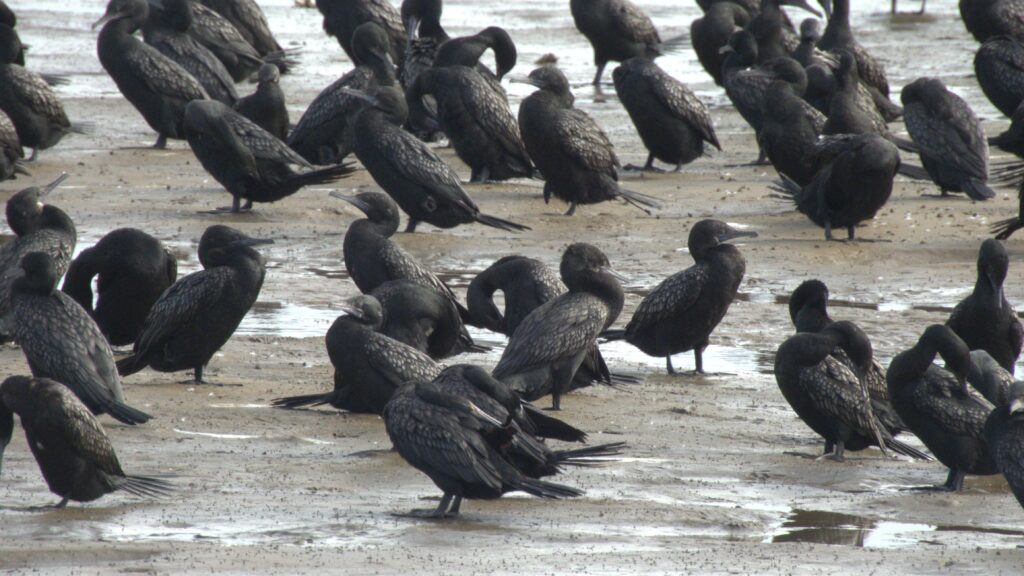
Perhaps the most remarkable feature of the Little Black Cormorant is its highly coordinated group feeding behaviour. In Moreton Bay’s estuaries, tidal flats and mangrove-lined inlets, hundreds, sometimes thousands of these birds gather to hunt.
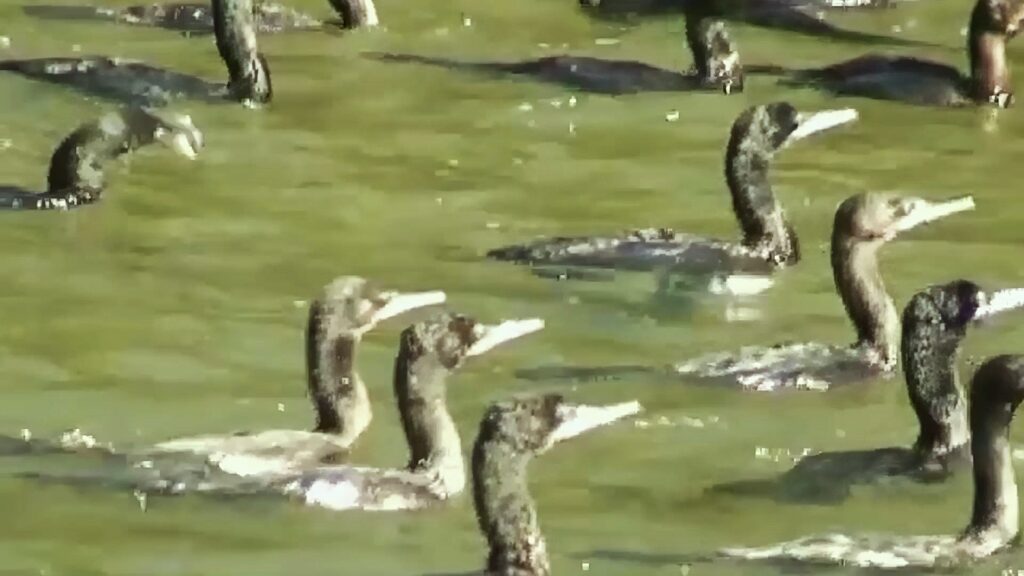
They hunt in coordinated groups, forming semicircles or lines to steer fish toward shallow water. Diving in unison improves their hunting efficiency and allows them to take advantage of large schools of fish including the Estuary Perchlet that inhabit the shallow waters of creeks and intertidal flats. This cooperative strategy not only improves hunting efficiency but also offers protection from aerial predators by strength in numbers.
Roosting: Communal rest and safety
After feeding, Little Black Cormorants often fly en masse to roosting sites, typically favouring high, bare branches of mangroves, sandbars and exposed tidal flats as well as riverside trees or man-made structures such as channel markers and pontoons. Gathering in dense clusters, their wings often held outstretched to dry. Unlike many waterbirds, cormorants lack fully waterproof plumage—an adaptation that aids in diving but necessitates post-feeding drying. Their communal roosting offers thermal benefits, enhanced vigilance against predators and reinforces social bonds.
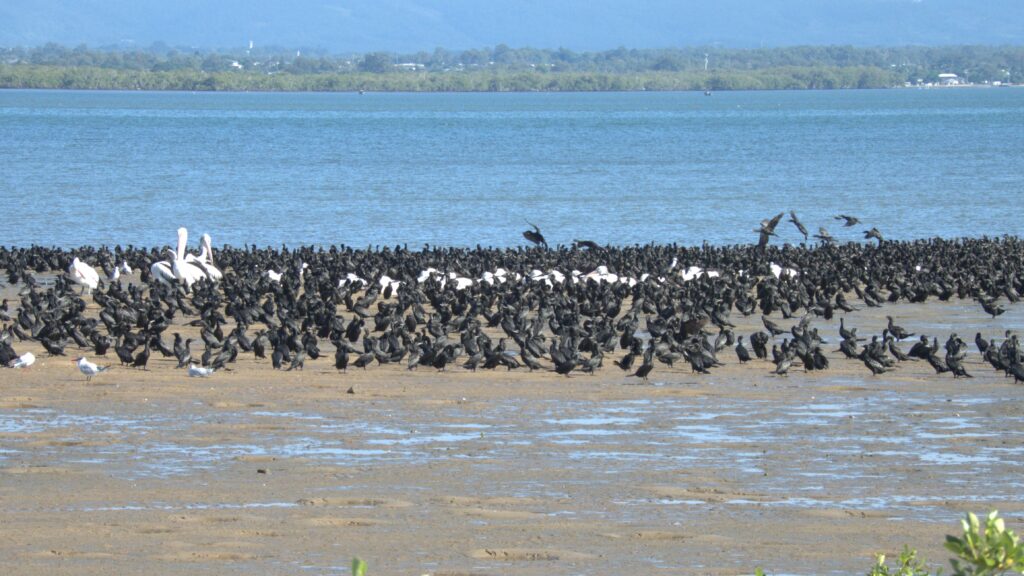
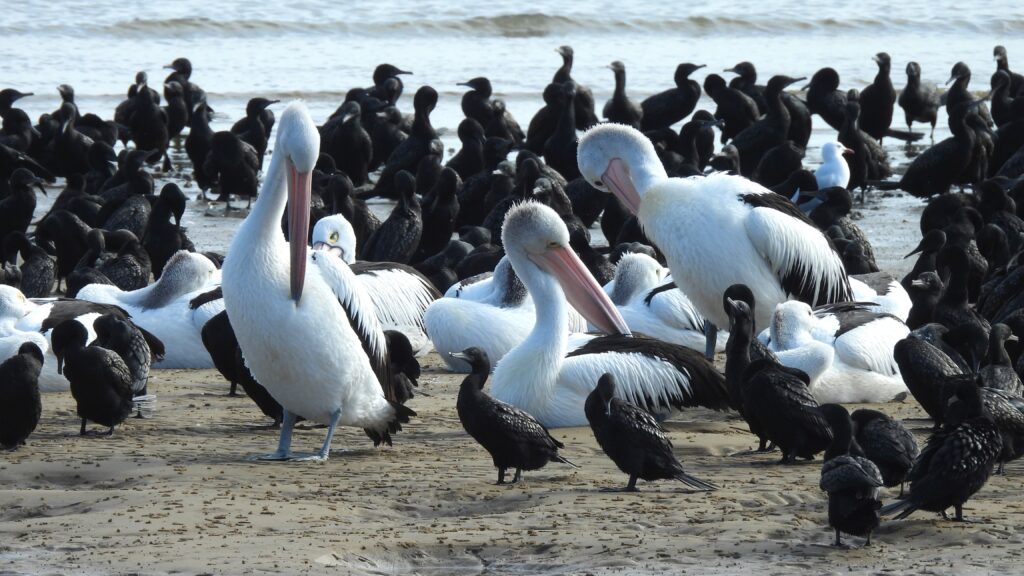
Other birds, also take advantage of the communal roost including Pied Stilts. Another iconic fisher is the Pelican, and here we can see 20 or so of these large birds resting amongst the cormorants and taking the opportunity engage in some personal grooming.
Smaller waterbirds including silver gulls and terns including the Greater Crested Tern and the Caspian Tern also hang around the cormorant flock.
Environmental markers of a dynamic ecosystem
These sizeable flocks are typically associated with aggregations of baitfish and consequently are influenced by environmental conditions. Water quality, temperatures and the availability of baitfish, including species such as the estuary perchlet, can vary considerably, particularly in response to climatic factors like rainfall events.
Large flocks of Little Black Cormorants in Moreton Bay can indicate a productive estuarine ecosystem. Their population numbers vary with fish stocks and wetland water levels, serving as an indicator species for conservationists and birdwatchers. Although they are sometimes thought to deplete fish stocks, research shows their effect is minor compared to habitat degradation, overfishing, and pollution.
Further reading
Lindsey, R.L., The Seabirds of Australia (1986). Little Black Cormorant pp 442 – 447 Angus & Robertson, Eden Park NSW
The Little Black Cormorant. Downloaded 22 June 2025. Little Black Cormorant | BIRDS in BACKYARDS